
How to Choose a Lead Generation Company: 10 Questions to Ask Before You Sign

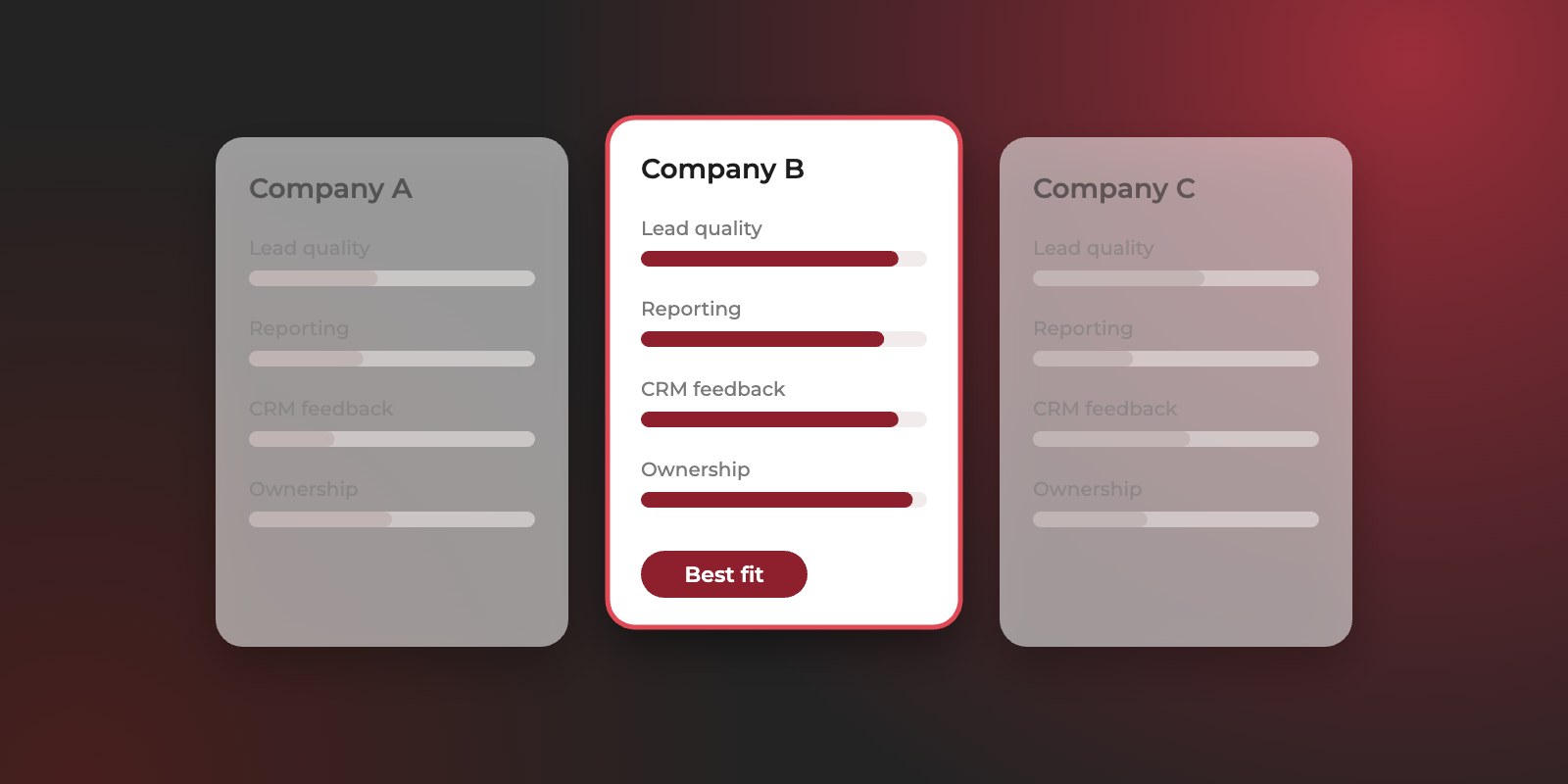
Choose a lead generation company by how it defines, measures and improves lead quality, not by how many leads it promises. The right partner agrees with your sales team what a qualified lead is, reports on the cost of each one, and leaves you owning your accounts and data.
That sounds obvious, but proposals can be surprisingly hard to compare. One quotes a cost per lead, another a monthly retainer, a third a guaranteed number of appointments. Each looks reasonable on its own, and none tells you how many of those leads your sales team will want.
This guide is for companies with an in-house sales team who are about to hire, or replace, a lead generation partner. It covers the main types of lead generation company, ten questions to ask before you sign, the red flags to watch for, and a scorecard you can use to compare proposals side by side.
What kind of lead generation company do you need?
Start by deciding which model fits your business, because “lead generation company” covers four very different services. They produce different kinds of leads, charge in different ways and suit different sales teams.
Lead lists and data providers
- Where the leads come from
- Contact databases bought or compiled by the provider
- What you pay for
- A list or a number of records
- The main quality risk
- The people on the list never asked to hear from you
- Works best when
- You have a strong outbound team and a narrowly defined target market
Cold calling and appointment setting
- Where the leads come from
- An outsourced team calls or emails prospects for you
- What you pay for
- Meetings booked, or a monthly retainer
- The main quality risk
- Meetings booked by a third party can be weakly qualified
- Works best when
- You sell high-value deals to a known list of target companies
Pay-per-lead networks
- Where the leads come from
- The provider’s own websites and ads
- What you pay for
- Each lead delivered
- The main quality risk
- Leads may be sold to more than one company, including competitors
- Works best when
- You sell in a high-volume consumer category
Lead generation through paid ads
- Where the leads come from
- Ads on Google, Meta, LinkedIn and other platforms
- What you pay for
- Ad spend plus a management fee
- The main quality risk
- Quality depends on targeting, forms and feedback from your CRM
- Works best when
- You have an established sales team and a budget for advertising
Lead lists and cold calling bring you contacts who haven’t asked to hear from you. Pay-per-lead networks bring enquiries, but made on someone else’s website and sometimes shared with other companies. Paid ads bring people who saw your own ad and chose to contact you, which suits sales teams that want to talk to buyers already interested in what they offer.
In the interest of honesty: we only do the last of these. You can see how it works on our lead generation page. Most of the ten questions in this guide apply to any model, and all of them will help you compare paid ads providers with each other.
What should you prepare before talking to lead generation companies?
Prepare five things before the first call: who your ideal customer is, what counts as a qualified lead, your current numbers, your budget, and how much follow-up your sales team can handle. With these ready, you can compare proposals against your own business instead of each provider’s sales pitch.
- Your ideal customer: industry or type of buyer, company size or budget range, locations you serve, and who makes the decision.
- Your qualified lead definition: what a lead must have for your sales team to pursue it.
- Your current numbers: leads per month, how many qualify, how many close, and your average deal value.
- Your budget: for ads and for management, separately.
- Your sales capacity: how many new leads your team can follow up properly each week.
10 questions to ask a lead generation company before you sign
These questions separate partners who focus on leads your sales team can close from those who focus on lead volume. For each one, here’s why it matters, what a good answer sounds like, and what should worry you.
1. How do you define a qualified lead, and who decides?
This is the most important question, because everything else is measured against it.
If you haven’t defined it yourself yet, our guide to what counts as a qualified lead includes a template.
2. What will you report on?
Reports show what a company is really optimizing for.
3. Will you connect to our CRM and use its data?
Ad platforms get better at finding qualified leads when they’re told which leads qualified. That information lives in your CRM.
4. Who will own the ad accounts and the data?
Your account history is valuable. Years of data on what worked help any future campaign, whoever runs it.
5. Who will actually work on our account?
The people in the sales meeting aren’t always the people running your campaigns.
6. How do you charge, and what does that reward?
Every pricing model encourages something. Make sure it encourages what you want.
7. What results have you achieved for businesses like ours?
Case studies are useful, but only if they measure the right thing.
8. How often will we meet, and will you talk to our sales team?
The people making the calls know things about lead quality that no report shows.
9. What will you need from us?
A good partner asks for things, because lead generation works best as a joint effort.
10. How will we know it’s working, and what happens if it isn’t?
Agree the measure of success, and when you’ll judge it, before you start.
What are the red flags when hiring a lead generation company?
The biggest red flag is a company that talks about lead numbers but never asks about your sales team. If you only have a few minutes, watch for these:
- A guaranteed number of leads, or a very low cost per lead, quoted before they understand your business.
- No questions about how your sales team qualifies, follows up and closes leads.
- Reports that stop at clicks, impressions or form fills.
- Ad accounts or data held in the provider’s name rather than yours.
- A fee structure where you can’t see how much of your budget reaches the ads.
- A long contract with no agreed point to review performance.
- Pressure to sign quickly before you’ve compared alternatives.
- No clear answer on how they store and use the personal data of your leads.
None of these proves a company is a poor choice on its own. Two or three together usually mean their incentives point at volume rather than at your revenue.
How do you compare lead generation proposals?
Score each company on the same criteria, weighted by what matters most to your business. Comparing headline prices alone rewards whoever quotes the lowest cost per lead, which tells you little about the cost of a customer.
Copy this scorecard, score each company from 1 (poor) to 5 (excellent) on every row, and multiply each score by its weight. The suggested weights put lead quality and ownership first; adjust them to your priorities.
| Criterion (question) | Weight | Company A | Company B | Company C |
|---|---|---|---|---|
| Defines qualified leads with our sales team (1) | 3 | |||
| Reports cost per qualified lead by campaign (2) | 3 | |||
| Connects to our CRM and feeds results back (3) | 3 | |||
| Ad accounts and data stay in our name (4) | 3 | |||
| Experienced people we’ve met run the account (5) | 2 | |||
| Clear pricing that doesn’t reward volume (6) | 2 | |||
| Relevant results measured on lead quality (7) | 2 | |||
| Regular reviews that include our sales team (8) | 2 | |||
| Asks for the right things from us (9) | 1 | |||
| Agreed success measure and fair terms (10) | 2 | |||
| Weighted total (out of 115) |
Use the totals to start a conversation, not to end one. If two companies score close together, the answers behind questions 1 to 4 usually decide it.
Frequently asked questions
What should I ask about data protection?
Ask how they collect, store and use the personal data of your leads, who can access it, and how it’s deleted when you part ways. Their answers should fit the data protection laws that apply to you, such as the UAE’s Personal Data Protection Law, or the GDPR if you collect leads in the EU.
How much should I budget for lead generation?
Work backwards from the number of customers you want. Divide it by your sales team’s close rate on qualified leads to get the qualified leads you need, then by your qualification rate to get total leads, then multiply by a realistic cost per lead.
For example, with round numbers: 10 new customers a month at a 20% close rate needs 50 qualified leads. At a 30% qualification rate, that’s about 167 leads. At AED 150 per lead, the ad budget comes to about AED 25,000 a month. Your own figures will differ, but the method shows whether a budget can realistically hit the target.
Is pay-per-lead a good deal?
It looks safe, because you only pay for results. In practice, it rewards the provider for delivering as many leads as possible, not the best ones, and you pay for unqualified leads along with the good ones. That’s why we don’t offer it.
How long before I can judge the results?
It depends on your sales cycle and lead volume, so agree the review point before you start. For long sales cycles, judge the early months on qualification rate and cost per qualified lead rather than closed deals, which may take longer to arrive.
Should I choose a lead generation company based in the UAE?
It isn’t essential, but it helps if your buyers are in the UAE or the wider GCC. A local team understands how buyers here prefer to enquire, including on WhatsApp, can write and manage Arabic campaigns, and works in your time zone.
What’s the difference between a lead generation company and a performance marketing agency?
They overlap. A performance marketing agency runs advertising judged on measurable results, which can be sales, sign-ups or leads. A lead generation company focuses on producing leads for a sales team. A performance marketing agency that specializes in lead generation, as we do, combines the two.
My current leads aren’t converting. Should I switch?
Not before you know why. The cause might be tracking, forms or follow-up rather than the ads, and a new provider won’t fix those. Our guide to why ad leads aren’t converting walks through how to find out.
How we answer these 10 questions
If you’re considering FlyRobin, here’s how we’d answer each question:
| # | Question | Our answer |
|---|---|---|
| 1 | Qualified lead definition | Agreed with your sales team before launch |
| 2 | Reporting | Cost per qualified lead by platform and campaign. We optimize for net profit and cost per qualified lead, not cost per lead |
| 3 | CRM connection | Automatic CRM feedback into Google Ads, Meta and LinkedIn, plus live CRM quality and UTM data |
| 4 | Account ownership | Your ad accounts normally stay in your name, so you keep full control of your data and history |
| 5 | Who runs your account | Senior strategists and media buyers only, with no junior hand-offs |
| 6 | Pricing | We don’t offer pay-per-lead, because it rewards volume rather than quality |
| 7 | Results | Anonymized case studies with qualification rates. On average, clients see a 35–70% reduction in cost per qualified lead |
| 8 | Meetings | Weekly reviews, with feedback from your sales team built in |
| 9 | What we need from you | Access to your ad accounts and CRM, and your sales team’s feedback on lead quality |
| 10 | Measuring success | Success measures agreed with you at the kick-off meeting. 85%+ of our clients stay beyond year two |
Ready for leads your sales team can actually close?
See how our lead generation works across Google Ads, Meta and LinkedIn, or get in touch and put these questions to us directly.
Get in touch